Thursday, November 17, 2011

Philippines, India re-affirm partnership in health services, medicine, global healthcare travell


 0share18 17
Philippine Health Secretary Enrique Ona (third from left) and His Excellency Ambassador Yogendra Kumar of India (fourth from left) are joined in the 1st Phil. Global Healthcare Forum by (from L-R) convenor and HealthCORE executive director Joyce Socao-Alumno; DTI undersecretary Cristino Panlilio; DM Healthcare Group executive director and NABH International board member Dr. Sanjiv Malik; ISQua vice chairman Dr. B.K. Rana; DOH undersecretary Ted Herbosa and HealthCORE CEO Juris Soliman.
Philippine Health Secretary Enrique Ona (third from left) and His Excellency Ambassador Yogendra Kumar of India (fourth from left) are joined in the 1st Phil.Global Healthcare Forum by (from L-R) convenor and HealthCORE executive director Joyce Socao-Alumno; DTI undersecretary Cristino Panlilio; DM Healthcare Group executive director and NABH International board member Dr. Sanjiv Malik; ISQua vice chairman Dr. B.K. Rana; DOH undersecretary Ted Herbosa and HealthCORE CEO Juris Soliman.
Health Secretary Enrique Ona and Indian Ambassador to the Philippines Shri Yogendra Kumar reaffirmed the cooperation between the Government of the Republic of the Philippines and the Government of the Republic of India on matters of improving the state of healthcare in both countries during the 1stPhilippine Global Healthcare Forum at the National Kidney and Transplant Institute (NKTI).
India and the Philippines are working together under a Memorandum of Understanding to exchange knowledge, expertise and training in various areas of healthcare and medicine for their mutual benefit. These areas include: Medical Education; Public Health; Hospital Management; Health Tourism; Drugs and Pharmaceutical Products; Medical Consumable Products; Medical Equipments; Communicable Disease Control and Surveillance; and Traditional and Alternative Medicine.
Ona and representatives of the Philippine health sector joined Indian experts on healthcare and global healthcare travel at the 1st Philippine Global Healthcare Forum in order to discuss and exchange information on how the Philippines, with the help of India, can develop into an international healthcare hub.
“India and the Philippines share similar health concerns. Particularly, both our countries need to meet the challenge of providing quality healthcare to the poorer and poorest segments of our populations. Both our countries will be able to exchange knowledge, expertise and training that will be of mutual benefit to our peoples,” said Secretary Ona.
One of the global healthcare experts at the Forum, Dr. Sanjiv Malik, noted that India’s success in developing its health sector to meet international standards was something that could be replicated in the Philippines.
“When India improved its international healthcare services, its entire healthcare sector improved. India was able to upgrade its healthcare system to international standards. As a result, both overseas patients and Indian patients are now receiving international quality health services and medical treatments at prices that are affordable to them.
“This is something I believe is very achievable for the Philippines. Your already are a caring people. You Filipino nurses, doctors and healthcare professionals give the highest level of caring and compassion to patients – it’s in your DNA. What you need to do next is to modify your present healthcare practices and systems to conform with international benchmarks. When you do that, you are already on your way to providing the best healthcare to your people and to becoming an international healthcare hub,” said Malik.
The 1st Philippine Global Healthcare Forum was convened by HealthCORE, a private corporation specializing in healthcare research and communications; and the official Philippine representative of National Accreditation Board for Hospitals and Healthcare Providers (NABH) in India. NABH is an ISQua-accredited, international accreditor of healthcare providers.

Healing organic plants sprouting in the city


By: 
rer

 10share253 194

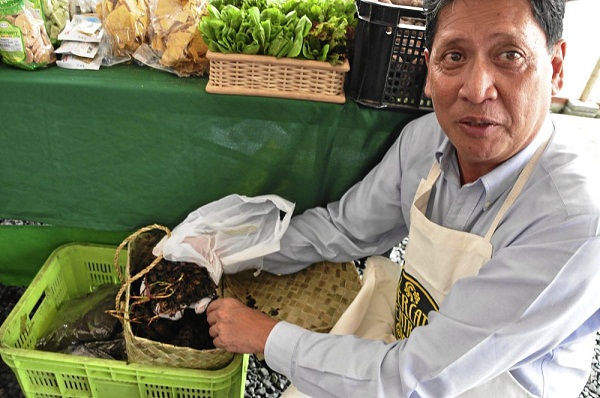
ORGANIC advocate De Castro shows content of his soil.
There is no doubt that plants are key to combat numerous degenerative diseases. But before that can happen, plants depend on minerals in the soil to make them achieve their full disease-fighting potential.
One of the most rigid but effective cancer therapies in the world, the Gerson Therapy, has always stressed the significance of soil content to plant potencies.
Max Gerson, MD, wrote in his book “A Cancer Therapy: Results of 50 cases and the cure of advanced cancer by diet therapy” that as a physician, he had spent much of his life investigating the nutritional aspects of disease. “I have often had occasion to observe a definite connection between dietary deficiencies and diseases, and between dietary deficiencies and a sick or poor quality of soil.”
Now popular
The importance of soil content would explain why organic vegetables and plants are now popular among the health-conscious. Determining which plants are grown organically, however, is another story altogether. There are certifications from known organic farmers’ organizations that ensure produce are genuinely organic.
There are a number of reliable locations in Metro Manila that offer organic vegetables and fruits during weekends. On Sundays, those open are the Legazpi Village Park in Makati and Centris in Quezon City. On Saturdays, the Salcedo Village Park in Makati, and the most recent weekend market to open, the Mercato Centrale at the corner of 34th Street and 8th Avenue in Bonifacio Global City, offers organic produce.
On October 8 this year, television personality and book author RJ Ledesma, a vegetarian, Ashtanga yoga instructor and Mercato Centrale cofounder, set aside 300 of the 1,500-square-meter space at Mercato to gather the members of Organic Producers and Trade Association (Opta), entrepreneurs of Gawad Kalinga Enchanted Farm, and cancer-preventive Vegan Macrobiotics by Chef Alice Ty to form an organic produce corner.
Vendors of organic sweet potatoes and Chia seeds, the Amsis Farms (producers of organic lettuce), the Kappia Network and its organic muscovado sugar, honey from wild bees of Abra, and sugarcane vinegar, Suoq International (makers of pure Argan oil and organic cooking products), Milea and its all-natural mineral make-ups, and Human Nature (all-natural/organic beauty and household products) were also on hand offering their products.
Turmeric from Pinatubo


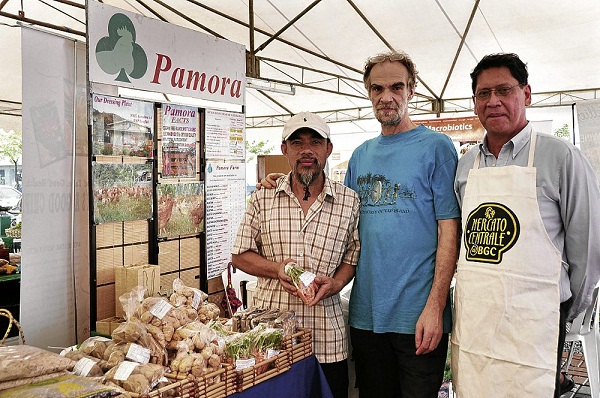
THREE organic advocates at Mercato will gladly explain nutritional contents of carrots, sweet potatoes, turmeric and brown rice.

Opta president Tony de Castro and Ledesma discussed with this writer the healing properties of the spice turmeric (and its more known vegetable form luyang dilaw). De Castro revealed that his luyang dilaw, from which he extracts his staple turmeric, grew on Pinatubo soil.
Inquirer Health has already featured the healing properties of turmeric, and the science behind it has been discussed extensively through interviews with Bharat B. Aggarwal, Ph.D., and Ransom Horne Jr., professor of cancer research and professor of cancer medicine (biochemistry) and chief, Cytokine Research Laboratory, Department of Experimental Therapeutics at the University of Texas MD Anderson Cancer Center. Aggarwal recently sent to Inquirer his article, coauthored with Vivek R. Yadav and published in the science journal Cancer Biology and Therapy titled “Curcumin: A component of the golden spice, targets multiple angiogenic pathways.”
The compound curcumin gives turmeric its golden yellow color.
Aggarwal cited that a number of recent investigations of curcumin have shown its efficacy in the prevention and treatment of multiple cancers. It has been shown to act as an antiangiogenic and antimetastatic agent in different types of in vivo studies. In addition, curcumin is affordable and has been proven to be safe in human clinical trials.
He admitted that more clinical trials testing curcumin against cancer are needed to fully realize its potential. And since curcumin has been proven to be nontoxic to humans, it has been routinely used in everyday applications, is inexpensive and provides a good alternative to other costly cancer drugs.
Photos by Tessa R. Salazar